
One of the first mistakes I made in my soon-to-be-married life was thinking the Jaimala was a game. Seriously. I’m competitive as hell. I don’t really know why, even noughts and crosses with children. I think it might be because I have four siblings and i am the youngest. I once (yes, only the once) did a 10km. I trained a bit, but never ran over 3km in one stretch. My sister had been training. On the day, I told my sister I was a bit worried. She told me not to be. She said just my sheer stubbornness and determination would get me to the finish line. In my head, I was like, Ahh, she believes in me. Turns out it did—I made it to the finish line, and yes, it was before her.
I’m Sikh, and my husband is Hindu Punjabi. The first time I read about this Jaimala ceremony was online. Google says the following about it:
“Jaimala/Varmala: After Milni, the bride and groom stand in the centre of the circle where the family is gathered and place a heavily-made garland of flowers (varmala) on each other to signify they accept one another and will love and live together.”
I am Sikh. In a traditional Sikh wedding, the bride and groom first see each other at the Anand Karaj. The groom enters the ceremony hall first. Once the bride arrives, the couple sits next to each other on the floor, with the bride sitting to the left of the groom, facing the Guru Granth Sahib. We’re not supposed to see each other before this.
Of course, the Jaimala request came from my MIL. My husband didn’t care, but naturally, her request won. I read more about it, and the general instruction was, “Don’t bow your head first.” The idea is the one who bows first, will have to bow in front of there respective partner for the rest of their/or your life.,‘So don’t bow!’ Game on.
I went first, tipping my head as far as my heavy chunni would allow, nearly snapping my neck in the process. As my chunni weighed approvimately 5kg and was pinned into my head. My husband, much taller, just chucked the garland over my head like he was at a fairground hoop toss. My turn. He stood on his tiptoes with his head tilted right back.
I thought, If you’re making me do this in front of my whole family, the least you could do is make yourself smaller. Then I felt my feet leaving the floor as my brothers lifted me to pop the garland around his neck. Good thing too, because my next plan was to kick him in the knees or a short sharp punch to the gut.
Later, after the doli—The Doli Celebration Marks The Bride’s Final Departure From Her Paternal Home—I cried my eyes out. Not pretty, delicate tears. Proper smears, snot, and streaked makeup. It was like I’d been forced into an arranged marriage. This was a love marriage in case you couldn’t feel the one in the story.
Fifteen minutes later, on the way to his house, I tried to sort my face out. My cousin was in the car with me. We arrived at a house packed with people, all ready to greet us at the door. Eventually, we made our way through the hallway and open-plan kitchen/living room towards the marquee in the garden.
Then, by the dining table, I spotted her—the bloody next-door neighbour bitch woman. Her superpower? Sensing weaknesses and weaponising it. Thin lips pursed, owl eyes wide, thickly rimmed with surma (black eyeliner). She announced loudly, “The new bride’s come into the house and hasn’t even touched the elders’ feet!”
My mum had always taught us never to do Pairi-Paina—touch our hands to people’s feet. So now I can’t do it, not even for show. That’s just how my brain works. If I tried, I would just feel faint or sick; my whole body would just be opposed to it and fail to function. I froze. My in-laws had also discussed this with my parents before the wedding. No one in their family had ever done this, and no one, especially a girl, would be expected to in the future.
I glanced around. My husband’s gran was sitting on a chair (the elder), mid-conversation. Then I looked at my MIL. Surely she’d shut this nonsense down. Nope. She nudged her head towards my husband’s Gran, silently instructing me to do it, both with her gesture and eyes.
Fuck!
I bowed down reluctantly, my heavy chunni weighing on my head. Just as I bent, I caught my husband’s gran eyes. As quick as a whip, she smacked my face away. In an upward motion. Causing me to jolt backwards.
This woman, in her 80s, who had lived through Indian Partition, lost her husband young, and worked hard at keeping her family together, stood up for me. Yet my MIL, who would never have let her own daughter touch anyone’s feet, decided not only to stay silent but to enforce it. Shame on her. I felt so much love towards my husband’s gran. She loudly said to me, “Don’t touch my feet with your hands; instead, embrace me.” I did so tight.
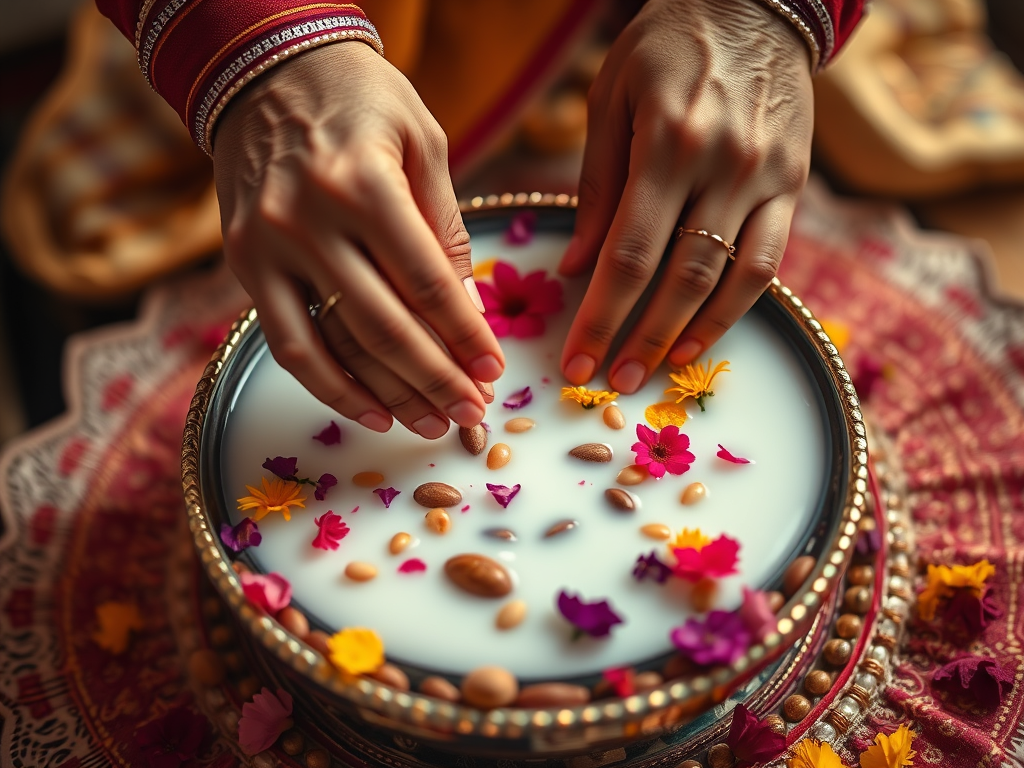
Later, we played the milk game. Milk and water are poured into a shallow bowl with petals, coins, and nuts. The aim is to find the coin first. The winner is supposedly the dominant one in the marriage. It is a good game to draw at as a woman; winning is not encouraged.
But I’m playing to win. I don’t cheat, but I give it my all. So, I went for it, milk splashing everywhere, drenching my lehenga. There was a lot of support for my husband. These voices soon died down when I held the coin high in victory.
I heard people muttering, “I knew it; she would win. She’s a clever girl, this one.” All said in jest and humour—but with very serious, knowing eye nods. I’m not clever—I wish I was. If I was, I’d definitely not be playing this game to win. People were acting like me winning somehow emasculated my husband.
My husband’s mum, standing beside me, heard the same comments. I saw her tense up, her posture suddenly straighter. I thought to myself you are welcome! Good posture is a gift.
Someone shouted it should be best out of three. So I beat him twice in a row.
Too much?
Leave a Reply