
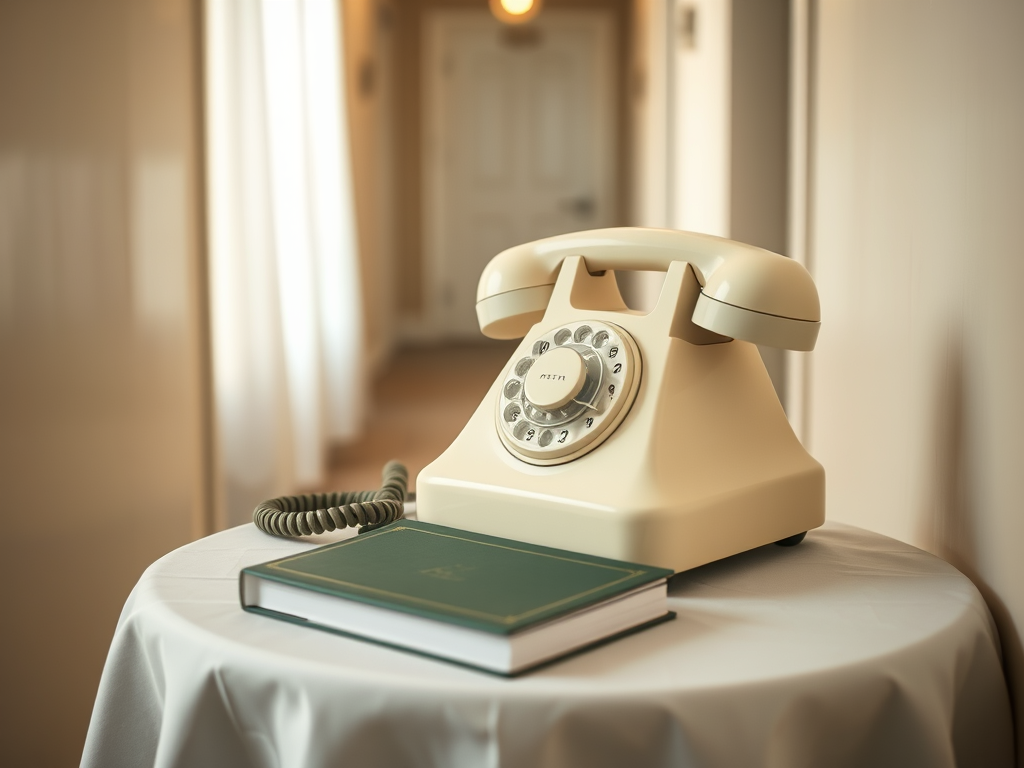
The phone ringing was an occasion in our house—but let’s be real, the only people who ever called were for my dad. When the phone rang and my dad was home, we’d wait to see if he made the first move. If he thought it was a customer calling to complain, he’d drag me or my sister to answer it. Otherwise, he’d pick up himself.
My dad was a builder/plumber/electrician all rolled into one. I’d like to call him our “Jack of All Trades,” but unfortunately, he was the master of none.
Customer calls were rarely pleasant—complaints about how he hadn’t turned up, the boiler wasn’t working, or the shower door had been installed the wrong way. The list was endless. We’d tell these angry people that he wasn’t home and that we had no idea when he’d be back. Meanwhile, he’d be standing there, glaring at us and miming for us to put the phone down.
There were good times, too. If he got a call while we were eating fish and chips, he’d abandon his plate, giving us the perfect window to steal some food. My dad was the condiment king. To this day, I’ve never been able to replicate his legendary sauce combinations. The moment he walked off, my sister and I were elbow-deep in hot chips, inhaling them like they were oxygen. He never said a word about it.
If my dad wasn’t home, it was our job to answer the phone and take a message. And taking a message was stressful. First, we had to find a scrap of paper, and then a pen that actually worked. Most numbers were written on the back of letters, until we were instructed to transfer them into the phone book. A working pen was like gold dust in our house. And every pencil on the phone table? Blunt. It was always an ordeal.
Getting the caller’s name right was another headache. Names were delivered with varying levels of Indian accent, and callers rarely wanted to repeat or spell anything. When Dad got home, he’d ask, “Did anyone call for me?” and we’d hand him our little scribbled note. He’d flip it around to show us it was written on a letter, then narrow his eyes. If anything was wrong with the name or number, we were fucked.
He’d examine the digits like they were written in code. Half of them might as well have been braille—our pens were usually out of ink, so we wrote with sheer force.
Then came the Spanish Inquisition.
“Who? Who is that? Is it the man that lives by the bridge?”
How the hell were we supposed to know?
“Yes, yes—I think I heard a river in the background!”
Or, “Was it the guy that always wears bright turbans?”
I’d think, Fuck me! Are we going to have to start asking callers where they live and what they’re wearing? My Punjabi wasn’t equipped for that. But we’d stay silent, with blank expressions.
Eventually, he’d ask us to add the number to the dreaded phone book. This was an A4 green monster, filled with every number my parents had collected since landing in England 50 years ago. It had no logical order—“B” could stand for a first name, a last name, or a nickname. Indians love nicknames. My favourite? Three brothers called Sunny, Money, and Honey. To this day, I have no idea what their real names are.
My mum would bring the phone book over when Dad wasn’t around. He didn’t mind talking on the phone, but he didn’t see the point of the rest of us using it. If we did, he’d glare at us until we hung up. In his mind, phone calls were like text messages: short and to the point. Pick up, yell the message, hang up.
The phone book was a mess of names and numbers, written by two functionally illiterate people. My dad honed his inner My Left Foot—some numbers looked like they’d been scrawled with his elbow. There were little pictures next to some entries to help. My sister, who lived abroad, had an aeroplane drawn next to her name. We had every number she’d ever had written down but were too scared to cross any of them out.
Whenever my mum asked for a number, it started with a backstory:
“It’s so-and-so’s brother’s mother’s auntie’s son’s wedding, and I need you to find the name Buckshee.”
Naturally, I’d check the “B” tab. Wrong.
She’d then remember that my dad had written it down—about four years ago. So now, we were flipping through pages looking for his handwriting. Scraps of paper would fall out like snowflakes.
By this point, my mum would start to panic. My dad was due home, and her window of opportunity was closing. Her panic would turn into rage.
“Can’t you read? What’s the point of sending you to school if you can’t even read?”
Telling her I could read only made it worse. She’d point to random names, demanding, “What does this say? Whose number is this?”
Sometimes, this worked—she’d get distracted and call someone else. Other times, she’d hit full meltdown mode:
“I can’t even call my own family because of my stupid children!”
And there I’d be, on my knees, sorting through every single piece of paper, praying for divine intervention.
She’d cap it off with:
“Other people’s kids would’ve found it by now. But I’m stuck with stupid kids who can’t even find a number in a telephone book!”
We still have that same book by the phone.
The other day, my mum walked into the living room with it in hand. I avoided eye contact and muttered a prayer.
She said, “I need to find a number. I think I wrote it on the first page.”
My son jumped up to help her.
It’s good for my kids to see how far I’ve come since those days.
He came back looking traumatised.
“Who writes a 7 like that?” he whispered.
Leave a Reply