
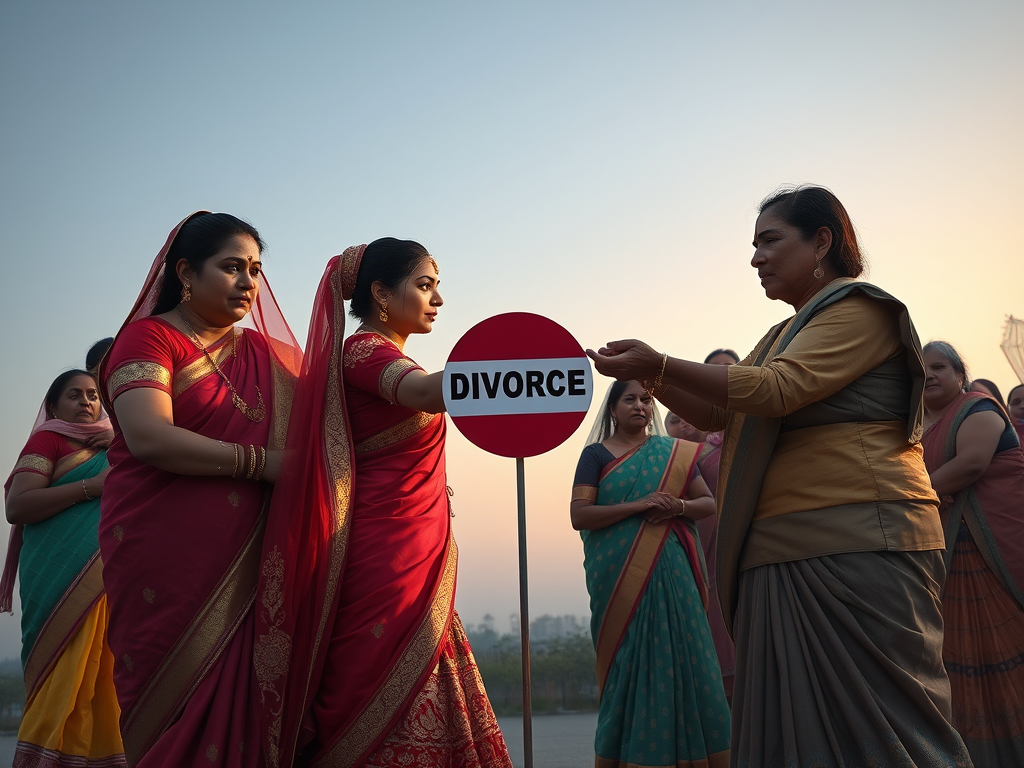
The way I was brought up was that if you got married, you stayed married. I say “if” loosely—we were very much expected to get married. In the rare occurrence of a divorce, 100% of the liability was placed on the woman. She should have worked harder to keep things together. Divorce was seen as a reflection of a woman’s character—her failure to sustain a relationship. Work harder, speak softer, look better, and give your time more freely. The woman would not only bring shame upon herself but also upon her family. If her family accepted her back, she would be sent home; otherwise, she would end up on a council waiting list.
Growing up, I saw women—mothers—left with nothing after a divorce. They were usually housewives with no access to money. The charge against the woman was often led by the mother-in-law. There was one marriage I knew of that quickly ended in divorce, solely because of the MIL.
The girl was quite ‘homely’ (she could cook a full Indian meal). The boy had big eyes, was tall and handsome—well, traditionally handsome. On the wedding night, the man left their marital room. He went and slept in his mother’s bed. This happened every night they were married. There were divided opinions about this divorce. Most people thought it was disgusting. Jokes were even made that maybe he was breastfed to sleep. However, there was a small army of women who wistfully looked at their own sons, murmuring audibly, “He must really love his mum.”
Then there was the case of the woman who was branded ‘pagol’—crazy. These were fairly common. The woman left because she was crazy. Why would she want to leave? The family was a good family. People would say, “We knew them back in India. Our villages used to share the same well.”
In this particular case, she left the marriage, house, and her daughter. The story was that she no longer wanted to be married to her husband. She was so crazy she didn’t have the mental capacity to take her daughter with her. Her husband was hailed as a hero for putting up with her for so long. Pagol was made homeless and turned to drink. It was in this state that she confronted the family in public, begging to see her daughter and asking for financial help. Unfortunately, this only cemented the case against her—the whole community shunned her.
Drinking in my culture is widely accepted for men. In fact, it is actively encouraged. If you were a man and didn’t drink, it was seen as strange—even if you were driving. But if you were a woman? No, no, no, no, no. That wasn’t a good look. In fact, women drinking when I was growing up was akin to loose morals—not a good, homely girl. Good girls drank in secret. Bad girls drank openly.
Pagol drinking on the street? In front of people and unkempt? The community did what they did best—gossiped behind closed doors but avoided the issue in public, turning her invisible on the streets. She no longer existed.
It was only later that I started hearing stories about her abusive treatment in that house. The reason? The same old story—the daughter-in-law did not meet the exacting standards of the mother-in-law. These women were housewives or cashiers in family-owned shops, most of them brought over from India on the promise of a visa. They were expected to live up to impossible expectations. It could be the way she cooked food, how she dressed for occasions, or simply how she carried herself. How you looked was important—you were now a reflection of the family. The way you spoke, the way you behaved—everything about you was up for comment. There was no pause for thought that you too were someone’s sister, daughter, or friend. You had to adjust to the new environment—there were new rules now.
The mother-in-law had not liked the fact that she had given birth to a daughter and not a son. She wanted to tell people she had a grandson. The blame for this? The woman. Always the woman. When a boy is born, the day is celebrated with Indian sweets; when a girl is born, the family is offered sympathies. “Maybe by the will of God, the next one will be a boy.”
When I look back on this now, I see a different version of the story. She had had enough. To leave, she had to leave her child behind. She had never worked. She was only educated to the age of sixteen, and even then, her results never mattered. She had moved straight from her father’s house into the house of her husband. She chose homeless freedom, and it cost her—her family, her friends, her community.
There was only one divorce story I heard where even the aunties chose not to blame the woman. I only heard this story from my mother—not even the gossip circle chose to take this one on.
We had a sweet, sweet relative. She looked like a porcelain doll—really fair-skinned, always wearing surma in her eyes and reddish-pink lipstick. She looked like an Indian Geisha. She had three children—two girls and a boy—all younger than me. She was so meek, and I don’t think I ever heard her utter more than a whisper. I didn’t like Uncle—her husband. He was a bearded, turban-wearing troll—short and strange-looking. He was always staring at us, talking and laughing with my dad, but otherwise brooding, never missing a thing.
My mum told me that he beat her regularly and verbally abused her. My dad told me he was building a nice house for his family.
As we got older, we lost contact with them. Then, one day, I saw her in the Gurdwara. She looked like the light of life had entered her body. She was wearing a uniform—she was a security guard. She was no longer small and frail. She was bigger, as though she was no longer afraid of taking up space.
It turned out her husband had been jailed—a convicted paedophile. He had raped one of his teenage daughter’s friends at their house. They got divorced.
Her whole family fell apart after the arrest. The son turned to drugs, and one of the daughters chose to live with the dad once he was released from jail, estranged from her mother. Only one daughter stayed with her.
Things have begun to change now, but progress is slow and not linear. A woman still bears the brunt of the blame and shame of a divorce, especially if she has children. The main difference is the speed of the Indian gossip machine. Fuelled by technology, gossip spreads at lightning speed. A divorce gets superseded quickly depending on the size of your family and friend circle. It has been helped by the rise of interracial marriages, affairs, and even the Ambani wedding!
Although divorce is becoming more normalised, the girl still can’t look too happy about it. She has to show suitable shame in how she presents herself. This could be by being extra accommodating to her ex-husband’s family. They could choose not to engage in conversation with her, but she was compelled to be ‘the bigger person’—respectful and demure. Otherwise, married women might get the wrong idea.
In my house, divorce has been normalised—for those who have had a divorce. But if you’re still married? Stay put. It’s not that bad.
In reality, my mum would never stay the night at my house if my husband was home. But if one of my divorced sisters suggests a sleepover? She starts packing her bag like she’s on Hunted. And when my dad tries to contact her, she suddenly becomes very vague about what day she’ll be returning home. Calls it a holiday (from my dad).
If my dad is having one of his moaning sessions, I hear her mutter how lucky my divorced sisters are. Living in a house without their ex-husband. How peaceful it must be. How she wishes she had the same. Not having to constantly hear the same rubbish every day from my dad.
Time’s up! “Men benefit from marriage; women benefit from staying single.” The secret is out.
Leave a Reply